


From labor planning to task management and real-time KPI tracking, this guide outlines seven practical ways to improve operational efficiency in retail and close execution gaps across stores.

Back to
Executive Summary
Operational efficiency in retail is the repeatable capability to deliver consistent sales and service outcomes across every store while minimizing wasted labor, inventory, time, and working capital. With margins under sustained pressure and footfall in structural decline, efficiency has moved from a finance exercise to a daily execution discipline.
This playbook defines operational efficiency in retail, sets out the KPIs to track, and walks through seven prioritized steps to improve it, from scheduling and task management to performance visibility and continuous improvement.
The fastest way to lose margin in retail is not a bad strategy. It is good strategy that fails to execute consistently across locations. Inventory distortion alone, the combined cost of out-of-stocks and overstocks, drained retailers an estimated $1.73 trillion globally in 2024, with out-of-stocks accounting for roughly $1.2 trillion of it. Most of that loss is an execution problem, and execution is fixable without a full operational overhaul.
Operational efficiency in retail is the consistent, repeatable capability to run each store so that target commercial and service outcomes, such as sales, conversion, on-shelf availability, and service standards, are achieved with the minimum necessary labor, inventory, time, and working capital.
Three adjacent terms are often confused with it:
Why Operational Efficiency Matters for Store Performance
Labor is the largest controllable cost in brick-and-mortar retail, which makes scheduling one of the highest-return levers available. Activity-based labor scheduling can cut store labor costs by up to 12% while improving both customer service and employee satisfaction.
Execution consistency is the other half. Individual store managers account for 25 to 35% of the productivity differences between locations, and that moving a bottom-decile manager to top-decile performance can lift a store’s productivity by 50 to 100%. The variation between your best and worst store is largely an execution gap, and execution gaps respond to systems and visibility.
Labor is the largest controllable cost in brick-and-mortar retail, which makes scheduling one of the highest-return levers available. Activity-based labor scheduling can cut store labor costs by up to 12% while improving both customer service and employee satisfaction.
Execution consistency is the other half. Individual store managers account for 25 to 35% of the productivity differences between locations, and that moving a bottom-decile manager to top-decile performance can lift a store’s productivity by 50 to 100%. The variation between your best and worst store is largely an execution gap, and execution gaps respond to systems and visibility.
The Retail Operational Efficiency KPIs to Track
Before changing anything, set a baseline. These are the core metrics that tell you where store-level efficiency is being won or lost, and how to calculate each one.
| KPI | What it measures / formula | Why it matters |
| Sales per labor hour (SPLH) | Revenue divided by total hours worked | Links staffing directly to financial output |
| Labor cost as % of sales | Labor cost divided by net sales | Tracks the largest controllable store cost |
| Inventory turnover | Cost of goods sold divided by average inventory | Signals stock health and working-capital use |
| In-stock / stockout rate | Share of SKUs available on shelf when needed | Protects sales and customer satisfaction |
| On-time task completion rate | Completed tasks divided by assigned tasks, on time | Shows whether HQ directives actually land |
| Shrinkage rate | Inventory loss divided by total sales | Surfaces theft, damage, and process erro |
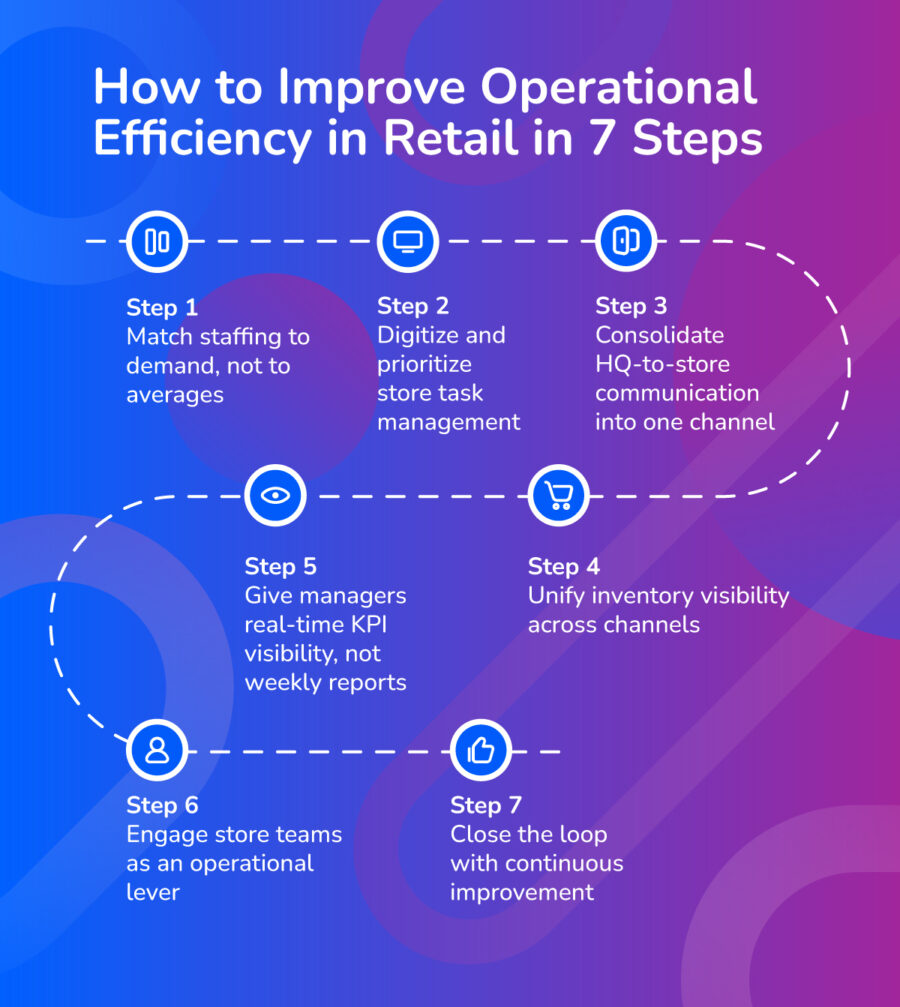
The steps below are ordered by impact against effort. The first three are quick wins most multi-location retailers can act on within a quarter; the later steps build durable advantage.
Static rosters built on last quarter’s averages create idle hours in quiet periods and service failures at peak. Move to activity-based scheduling that uses POS and footfall data to align headcount with real hourly demand. Cross-train staff and hold a small flex pool where demand is volatile, so coverage bends with the day instead of breaking.
Fragmented checklists, email directives, and verbal instructions cause missed planogram resets, late promotions, and skipped compliance checks. Move tasks onto a single platform with role-based feeds, photo verification, and clear SLAs on critical work. Sequence tasks by impact, not habit, and report completion back to managers daily so a missed reset is caught the same shift, not the next audit.
When directives arrive through email, intranet, and paper at once, store teams miss priorities or ignore the noise. Consolidate communication into one frontline channel with read-and-acknowledge confirmation, attach tasks to messages, and require proof for critical executions. Add a structured route for stores to escalate issues back to HQ so problems surface early instead of in next month’s numbers.
Channel-dedicated stock pools and manual counts drive both stockouts and overstock. Move toward a single inventory view shared across channels, enable store-as-fulfillment for click-and-collect where the economics work, and trigger replenishment automatically from real-time stock signals rather than weekly manual counts.
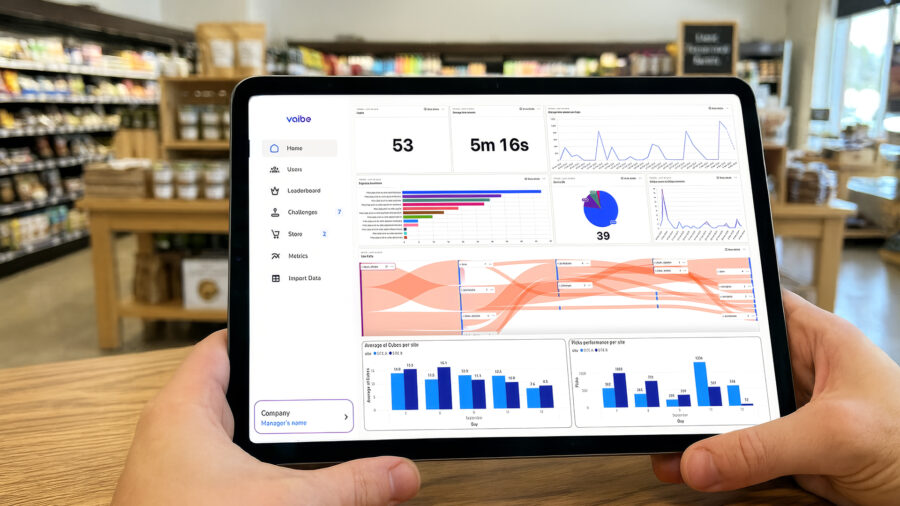
By the time a weekly report lands, the chance to course-correct has passed. Build store-level scorecards that integrate sales, inventory, workforce, and task data, with separate views for store, area, and HQ. Set thresholds and automated alerts so exceptions get attention the moment they appear. vaibe adds a layer standard dashboards do not: it translates those KPIs into daily challenges and team leaderboards at the associate level and delivers recognition the moment a target is hit, turning a reporting metric into a behavior people act on during the shift.
Engagement is an operational lever, and a measurable one: engaged teams execute more consistently and turn over less. In fact, research shows that companies with high employee engagement achieve 23% greater profitability and 18% higher sales productivity. Pair structured two-way communication and bite-sized in-flow training with recognition tied to store analytics.
Gains from any single initiative fade without follow-up. Standardize store-visit templates, require evidence-backed issue resolution, and set follow-up SLAs on everything raised through frontline channels. Feed the lessons from one store back across the estate so a fix made in one location does not have to be rediscovered in fifty others.
How CITY Furniture Lifted Productivity by 11%
CITY Furniture, a high-volume Florida retailer, needed to keep productivity consistently high across distribution teams with varying skill levels and shift patterns. Standard reporting told managers what had happened, but it did little to change behavior in the moment or to keep physically demanding work motivating enough to retain people.
Working through its warehouse management system provider and vaibe, CITY Furniture turned existing daily KPIs into gamified performance challenges. Teams tracked rankings in real time and earned recognition tied directly to measurable output, using data associates were already generating rather than adding new hardware or workflows.
Results:
The shift was not new technology. It was making performance visible and rewarding daily, so the right behaviors repeated and turnover eased on demanding work.
How do you improve operational efficiency in retail?
Improve operational efficiency in retail by aligning staffing to real demand, digitizing store task management with verified completion, consolidating HQ-to-store communication, unifying inventory visibility across channels, and giving managers real-time KPI scorecards. The largest gains come from closing the gap between targets set centrally and consistent execution on the shop floor, supported by engaged store teams and continuous improvement loops.
What KPIs measure retail operational efficiency?
The core KPIs are sales per labor hour, labor cost as a percentage of sales, inventory turnover, in-stock or stockout rate, on-time task completion rate, and shrinkage rate. Pair these operational metrics with customer measures like conversion rate and CSAT or NPS by store, so efficiency gains are never made at the expense of the customer experience.
What is the difference between operational efficiency and operational excellence?
Operational efficiency is a concrete, measurable objective: achieving target outcomes with the least waste of labor, inventory, time, and capital. Operational excellence is the broader cultural ambition that institutionalizes continuous improvement, innovation, and customer-centricity across the business. Efficiency is one measurable performance objective inside the wider excellence agenda.
How does employee engagement affect retail efficiency?
Engagement is a direct operational lever, beyond its role as an HR metric. Engaged store teams execute tasks more consistently, deliver more reliable service, and leave less often, which lowers recruitment and retraining costs. Recognition tied to performance data and gamified KPI visibility convert strategic targets into daily behaviors, which is where execution consistency is won or lost.
Where should a retailer start to reduce costs without hurting service?
Start with scheduling and task management, the two highest-return quick wins. Activity-based scheduling can cut labor costs by up to 12% while improving service, and digitized task management raises on-shelf availability by ensuring critical work is completed on time. Both reduce waste without removing the staff hours or service quality that protect sales.
Share:


Retail’s productivity crisis isn’t a technology problem, it’s a people problem.
The Frontline Reset explores why frontline turnover is eroding performance in retail and what leading companies are doing to build stable, high-performing teams.
Sales teams may strive to achieve numbers and sales, but their motivation often goes beyond that. So, what should managers to keep their sales teams motivated?
Learn what motivates employees and how strategies like gamification, recognition, and professional development can boost engagement and performance.
Explore gamification in daily life through fitness, retail, and education with “invisible games” examples.