


Learn how to manage warehouse employees with practical steps on hiring, KPIs, shift structure, coaching, and recognition that keep output consistent.

Back to Blog
Executive Summary
Most warehouse improvement budgets go to systems, slotting, and automation. The difference between what a facility produced on Tuesday and what it produced on Wednesday is usually simpler than that: a new hire nobody trained properly, a shift that started without a visible target, or a supervisor whose last performance conversation with the team was a quarter ago. Those are management problems, and they are fixable without capital spending.
Managing warehouse employees means hiring, onboarding, directing, coaching, and retaining the frontline team that receives, picks, packs, and ships goods so that output stays consistent across shifts and people stay long enough to become productive.
It covers four things a warehouse management system cannot deliver on its own:
Warehouse management oversees inventory, slotting, and process design. Warehouse people management supervises the team executing that process, and it is where most of the unexplained variance in daily output sits.
The supervisor is the single largest variable in team performance: 70% of the variance in team engagement is attributable to the manager. In warehousing, where supervisors are typically promoted from the floor for being fast, accurate operators, that training gap is the default condition rather than the exception.
Replacing the people who leave is expensive. The cost of replacing one employee could be at one-half to two times their annual salary, and 52% of employees who quit voluntarily say their manager or organization could have prevented it.
Hand laborers and material movers represent over a million openings each year (in the U.S. only), most of them created by workers leaving the occupation rather than by growth. 83% of supply chain professionals recognize a workforce and talent shortage as a live challenge for their operations.

Output per hour tells you what happened. These six metrics tell you whether management is the reason, and they give a supervisor a baseline to improve against.
| Metric | What it measures | Why it matters |
| Time to full productivity | Days for a new hire to reach the role’s target rate | The clearest test of whether onboarding works |
| 90-day retention rate | Share of new hires still employed after 90 days | Early exits waste the entire training investment |
| Shift-to-shift output variance | Gap in units or lines per hour between shifts | Isolates the management effect from the process |
| Output per operator | Individual rate against the role target | The factual basis for coaching conversations |
| Unplanned absence rate | Unplanned absence as a share of scheduled hours | An early warning signal of disengagement |
| Recordable incident rate | Recordable injuries per 100 full-time workers | Tracks whether pace is being bought with safety |
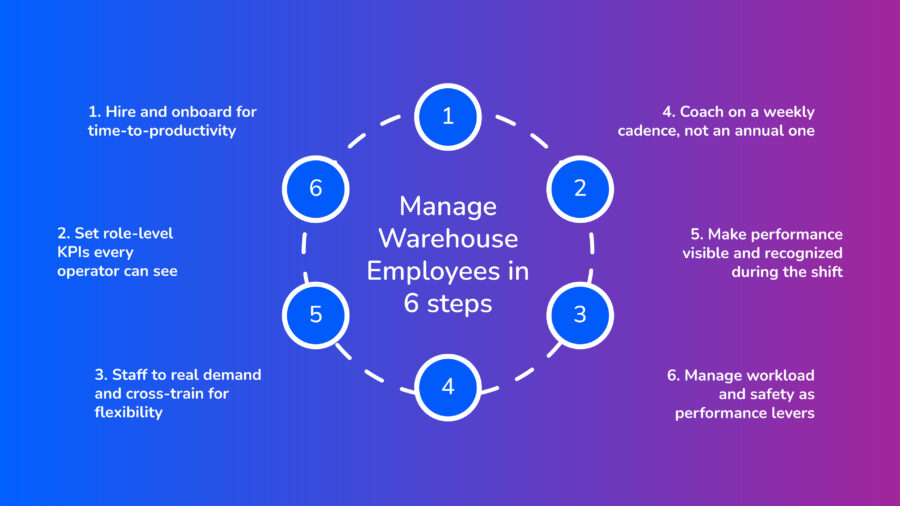
The steps below run in order of when they touch an employee, from the first day to the thousandth. Each one is a supervisor-level action, not a corporate program.
Measure onboarding by how long a new hire takes to reach the target rate for their role, not by how many forms were completed on day one. Pair every new starter with a named experienced operator for their first two weeks, set a written rate expectation for weeks one, two, and four, and check in on day 7 and day 30. Training on lifting technique and equipment handling belongs in that first week, not after the first incident.
A target nobody can see is a target nobody manages to. Define one primary rate metric per role, picking, packing, receiving, or loading, and one quality metric alongside it, then publish both where the work happens. Pickers should know their lines per hour target and their accuracy target before the wave starts, not read about them in a monthly summary.
Never publish a speed target without its quality pair. Pushing rate alone raises the error rate, and mis-picks consume the capacity the speed push was meant to create. For the full picture on prevention, see our guide to reducing warehouse errors.
Rosters built on last quarter’s averages create idle labor in the quiet hours and service failures at the peak. Build the schedule from inbound and outbound volume by hour, then cross-train enough of the team that people can move to wherever the queue is forming. Cross-training doubles as a retention lever, because it signals investment in the individual.
had no conversation with a manager or leader about their job satisfaction or their future in the three months before they resigned. A 10-minute weekly one-to-one closes that gap. Keep it structured: last week’s numbers, one thing that went well, one specific thing to change, and one obstacle the supervisor will remove.
End-of-day reporting is too late to change an outcome. Surface hourly progress against the target on zone displays and operator screens so people can self-correct while the shift is still running, and pair it with recognition that lands the moment a target is hit.
Fatigue, injury, and absence remove trained output from the floor as effectively as a resignation does. Rotate physically demanding tasks across a shift, watch the recordable incident rate alongside the rate metrics, and treat a spike in either as the same signal. Address the flow rather than the people and see the natural increase in your warehouse throughput.
CITY Furniture, a high-volume Florida retailer, ran distribution teams with a wide spread of skill levels and shift patterns. Standard reporting told supervisors what had already happened and did little to keep demanding work motivating enough to retain people.
Working through its warehouse management system provider and vaibe, CITY Furniture turned the KPIs its teams were already generating into gamified daily challenges. Operators tracked their standing in real time and earned recognition tied to measurable output, with no new hardware and no extra workflow for supervisors to administer.
Results:
The lesson for supervisors: consistency across shifts came from making the same targets visible and rewarding to every operator, not from finding better operators.
How do you manage warehouse employees effectively?
Manage warehouse employees by onboarding against a time-to-productivity target, setting a visible rate and quality KPI for every role, scheduling to real hourly demand, coaching weekly rather than annually, and recognizing performance during the shift. The consistent pattern in high-performing facilities is short feedback loops: targets people can see, and conversations that happen in days rather than quarters.
How do you motivate warehouse workers?
Warehouse work is repetitive and physically demanding, so motivation depends on visible progress rather than annual incentives. Show operators their output against target during the shift, recognize good performance the day it happens, and give people a route to learn additional functions. Recognition tied to real data lands better than generic praise, because operators know which numbers are theirs.
How do you reduce warehouse employee turnover?
Start with the first 90 days, where most avoidable exits happen, and fix onboarding so new hires reach target rates before frustration sets in. Add weekly one-to-ones, since a majority of voluntary leavers report no conversation about their satisfaction in the three months before quitting. Cross-training and predictable schedules address the reasons people cite most often.
What makes a good warehouse manager?
A good warehouse manager sets clear role-level expectations, coaches with data rather than impressions, staffs to actual demand, and protects the team from unmanaged physical strain. Technical fluency in the process matters, but the differentiating skill is the feedback cadence: the ability to run short, specific, regular performance conversations that change behavior before the numbers slip.
How do you measure warehouse team performance?
Measure warehouse team performance with a rate metric and a quality metric together, such as lines per hour paired with picking accuracy, then add time to full productivity, 90-day retention, shift-to-shift variance, and unplanned absence. Rate alone misleads, because speed bought with errors or injuries reverses within weeks.
Share:


Employee turnover in warehouse settings is an issue companies currently face. Repetitive work and lack of recognition are some of the main causes for it. But how can this issue be tackled? Gamification might be the answer.
Learn how intrinsic and extrinsic motivation can be increased with the right tools in any team.
Learn effective strategies to boost employee engagement, retention, and workplace satisfaction.