


Learn what causes warehouse errors, how to calculate your error rate against benchmarks, and 5 steps to cut picking, packing, and shipping mistakes.

Back to Blog
Executive Summary
Warehouse errors are mistakes made during receiving, storage, picking, packing, or shipping that send a customer something other than what was ordered, or leave system records out of step with physical stock. Every facility makes them. What separates operations is how fast they catch them and how much each one costs.
High order accuracy is not won with a single purchase. Facilities that hold it combine slotting design, validated picking workflows, and a frontline team engaged enough to care about quality when nobody is checking.
This guide breaks warehouse errors into five categories, shows how to calculate your error rate against current benchmarks, and sets out five steps to reduce errors without giving up throughput.
A single wrong item does not end when the customer complains. It becomes a return shipment, a receiving-dock inspection, a restock, a replacement pick, and a second outbound freight charge, all against an order that was priced for one pass. Order accuracy is the cheapest margin in the building, and most facilities cannot say what theirs is worth.
Warehouse errors are mistakes in receiving, storage, picking, packing, or shipping that cause a customer to receive something other than what was ordered, or cause system inventory records to diverge from physical stock.
They are rarely random. Each type traces back to a gap in the layout, the picking process, or the verification steps around them.
| Error type | What goes wrong | Most common root cause |
| Picking errors | Wrong item, wrong quantity, or a missed line | Look-alike SKUs in adjacent slots; picking from memory instead of directed instructions |
| Packing errors | Right items, wrong carton, label, or paperwork | No scan or weight check at the pack bench |
| Inventory inaccuracies | System stock does not match physical stock | Batch transaction processing and manual adjustments |
| Shipping mistakes | Correct carton, wrong vehicle, carrier, or route label | WMS, ERP, and transport systems not synchronized in real time |
| Receiving discrepancies | Unverified vendor quantities, damage, or labeling | No check against the purchase order at the dock |
Receiving discrepancies deserve particular attention. An error entered at the dock propagates through storage, picking, and shipping, so downstream accuracy work is spent correcting bad data instead of preventing new mistakes.
The cost of a mispick is easy to underestimate because it is split across departments. The visible expense is the replacement unit. The hidden expense is double-handled labor, return freight, expedited outbound freight, wasted packaging, and customer service time.
Returns are where those errors surface commercially. In the US, retailers expect 15.8% of annual sales to be returned, worth $849.9 billion, rising to 19.3% of online sales. Fulfillment errors are one slice of that flow, but every one enters it at full reverse-logistics cost with no revenue attached.
The customer’s cost is harder to reverse. In the same research, 71% of consumers said they are less likely to shop with a retailer again after a poor returns experience, up from 67% a year earlier. Customer satisfaction is decided in the aisle where the item was picked.
Before changing anything, set a baseline. Two calculations cover most operations:
Error rate = (Errors ÷ Total picks or orders) × 100
Order accuracy = ((Total orders – Orders with errors) ÷ Total orders) × 100

Measure both. Item-level accuracy shows where the picking process is failing, while order-level accuracy shows what the customer experienced. Strong item accuracy can still produce poor order accuracy when errors cluster in multi-line orders.
Research shows how fast benchmarks are moving. Order picking accuracy jumped from the 33rd most-tracked warehouse metric in 2024 to the third in 2025, even as performance slipped slightly. Accuracy is getting more attention and becoming harder to hold.
Put the number in context before setting a target. A high volume operation shipping 10,000 orders a week at 99% order accuracy still generates 5,200 corrections a year, each carrying the full reverse cost above.
The steps run from physical design to digital validation to daily behavior. The early ones cost little, the later ones stop the gains fading.
Layout drives both fatigue and misidentification. Place fast-moving items closest to packing and at waist-to-shoulder height, which reduces travel time and the bending that wears operators down. Then break up the adjacencies that cause the wrong item to be picked: never store two sizes, colors, or near-identical packages side by side. Re-slot as velocity shifts, not once a year.
Zone picking keeps operators in a familiar area, so they build SKU expertise. Batch picking collects several orders in one pass and suits high volume, low-line profiles. Wave picking groups releases around carrier cut-offs. The wrong fit causes errors directly, particularly batch picking across a wide SKU range without strong system direction. To prevent picking errors in the warehouse, operations need to align their picking strategies with strong system controls.
Barcode scanning at both the bin location and the SKU removes memory and visual judgment from the pick and pack process. The operator cannot advance until the system confirms the match, which turns a silent human error into a blocked step. Treat device reliability as an accuracy issue too: a frozen scanner pushes operators back to working from memory.
Accuracy is cheapest to fix at the two ends of the flow. At the dock, check vendor quantities, damage, and labeling against the purchase order before stocking, so bad data never enters the warehouse management system. At the pack bench, scan-verify stations and inline weight checks catch what survived picking. Cycle counting keeps the record honest in between.
End-of-day reporting tells you an error happened. It cannot stop the next one. Surfacing accuracy and throughput by zone during the shift lets operators self-correct, and team leaders intervene while the shift is still recoverable.
Technology narrows the opportunity for human error, but it does not create the intent to work carefully. A disengaged operator will scan around a verification step or wave through a discrepancy that a motivated one would flag.
That intent is measurable, and it is under pressure. Employees extremely proud of the quality of what their organization produces fell to 28%, with transportation and warehousing recording the largest drop of any industry at 14%. Pride in quality is the exact attitude that catches a wrong item before it leaves the building.
Recognition is the practical lever, because accuracy is invisible work: a correct pick produces no signal, an error produces a complaint. Rewarding quality as consistently as speed stops operators optimizing only for the number that gets noticed.
CIN, a Portuguese paint and varnish manufacturer with more than 2,000 employees, had the same problem at two facilities: an automated distribution center and a raw materials warehouse. KPIs were collected manually and only visible the next day, equipment downtime was estimated, and teams had no view of their own performance while they could still act on it.
vaibe’s operational performance layer was deployed across both sites on top of the existing systems, adding daily challenges, real-time public displays, and custom tracking for downtime, attendance, and work time.
Results:
Isabel Lopes, Operations Manager at CIN, credited the platform’s ease of use, tracking, and integration. The transferable lesson: performance data that arrives the next morning is a report, and a report has never corrected an error mid-shift.
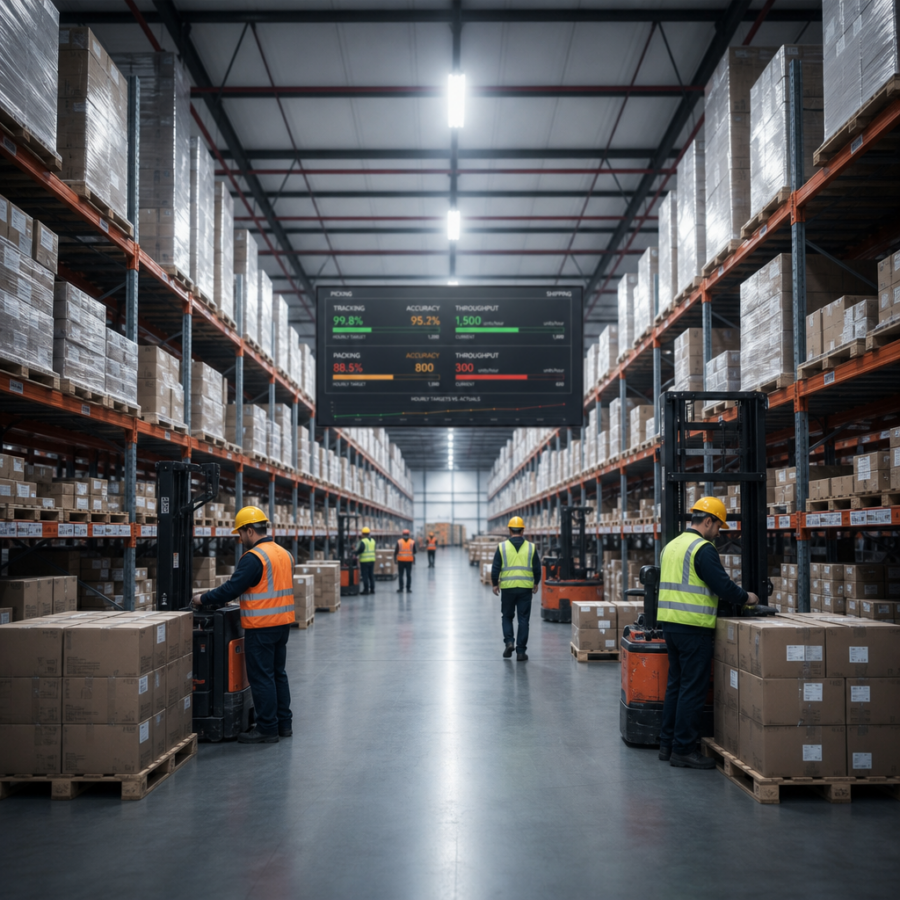
The most common warehouse errors are picking errors, packing errors, inventory inaccuracies, shipping mistakes, and receiving discrepancies. Picking errors are the most frequent and most visible to customers, usually a wrong item, a wrong quantity, or a missed line. Receiving discrepancies are the most damaging, because bad data entered at the dock corrupts every downstream process.
Reduce operator errors by removing the steps that rely on memory: document standard operating procedures and keep them on the floor, re-slot so look-alike SKUs are never adjacent, and require barcode scanning at bin and SKU level, so the system blocks a mismatch. Then replace next-day reporting with real-time visibility so operators can correct accuracy during the shift.
Divide the errors detected in a period by the total picks or orders completed in the same period, then multiply by 100. For order accuracy, subtract orders containing errors from total orders, divide by total orders, and multiply by 100. Track both figures, since they fail in different ways.
Barcode scanning removes a large share of picking errors by forcing validation before a transaction can advance, but it does not eliminate them. Errors persist where scanning is bypassed under time pressure, where devices are unreliable, or where the inventory record is already wrong.
Operations-focused gamification sits on top of the existing warehouse management system and reads task data operators already generate through scanning, so no extra steps are added to the picking process. That data becomes live challenges and recognition. Because accuracy is rewarded alongside speed, it discourages the trade-off where operators pick faster by checking less.
Share:


See how CIN used vaibe’s operational performance layer to achieve a 13% productivity increase, full real-time KPI visibility, and 100% employee satisfaction across two warehouse sites.
Implementing gamification solutions in the workplace can be a driver of business results. Let’s explore how.
Understand how to immediately start boosting business productivity with gamification tools that drive real results.