


Explore practical ways to lower picking-related costs, improve order accuracy, and build a more reliable, efficient warehouse operation.

Back to Blog
Executive Summary
Picking errors are one of the most costly and preventable sources of waste in warehouse operations, draining revenue through returns, rework, and lost customers with every mispick. This article explains what causes picking errors, how to measure your accuracy rate against industry benchmarks, and the most effective strategies to reduce them.
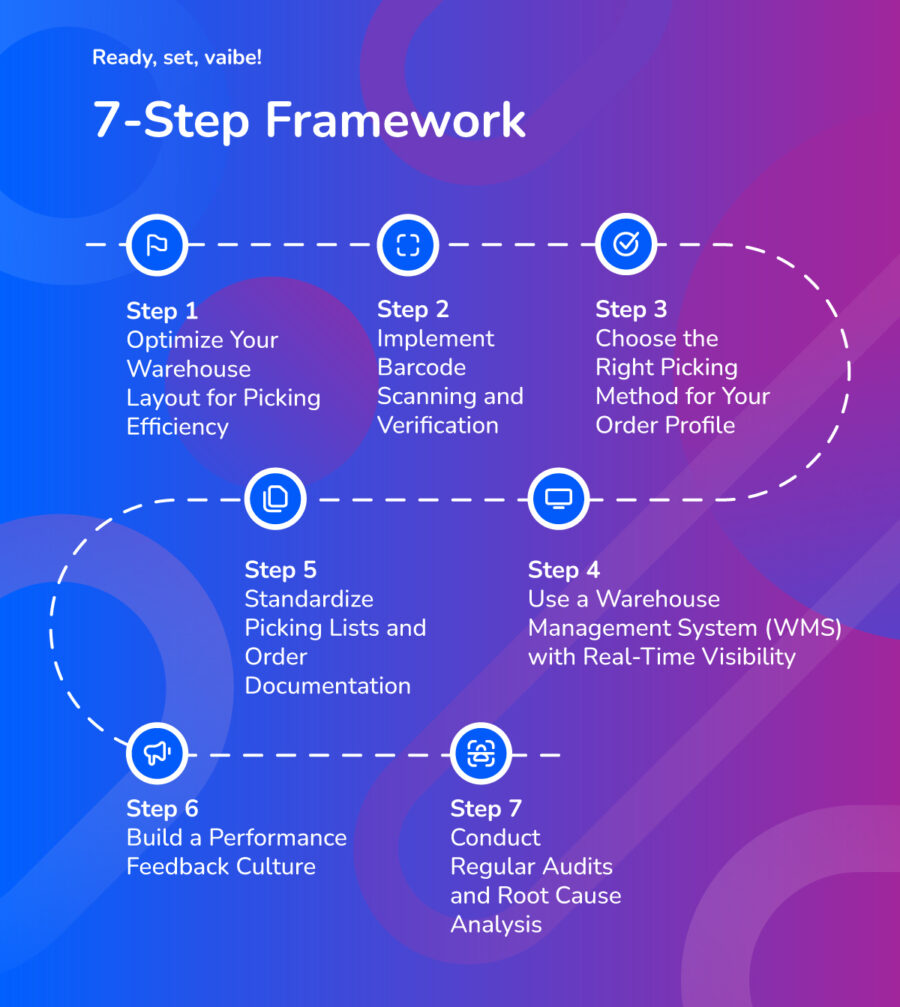
You’ll find a 7-step framework with warehouse layout and barcode verification, picking method selection, and team performance tools, that can help recover hundreds of thousands of dollars in annual operating costs.
Picking errors are one of the fastest ways for a warehouse to lose money, quietly, every day. The cost does not show up in a single line item, but it accumulates through returns, reshipments, customer service escalations, and customers who simply do not come back.
A warehouse running at a 2% picking error rate and processing 500 orders per day loses an estimated $150,000 in direct costs annually, before accounting for customer churn or reputational damage. Most of these errors are systematic, not random—which means they are fixable.
A warehouse picking error occurs when a picker retrieves the wrong item, the wrong quantity, or the wrong variant from inventory during the order fulfillment process.
Common error types include:
The financial impact of picking errors goes far beyond the cost of the wrong item. Each mispick triggers a chain of downstream costs: return shipping, reprocessing, re-picking, re-shipping, and customer service resolution.
Research from Kardex estimates that picking inaccuracies can contribute to hundreds of thousands of dollars in annual losses for a typical distribution center once rework, returns, and labor are fully accounted for.
Customer impact is equally severe. Studies show that accuracy, more than a quality metric, is a business survival metric:
Before implementing any improvement strategy, it helps to understand where your warehouse sits relative to industry standards.
The formula to calculate picking accuracy:
Picking Accuracy = (Error-free orders ÷ Total orders) × 100
Track this daily and review trends weekly. Even a 1-point improvement from 98% to 99% cuts error-related costs in half at the same order volume.
A poorly organized warehouse layout is one of the most common drivers of picking errors. Long travel distances, inconsistent slot assignments, and mixed-SKU storage all increase the likelihood of mistakes.
A logical warehouse layout goes beyond improving speed; it removes the conditions that cause errors.
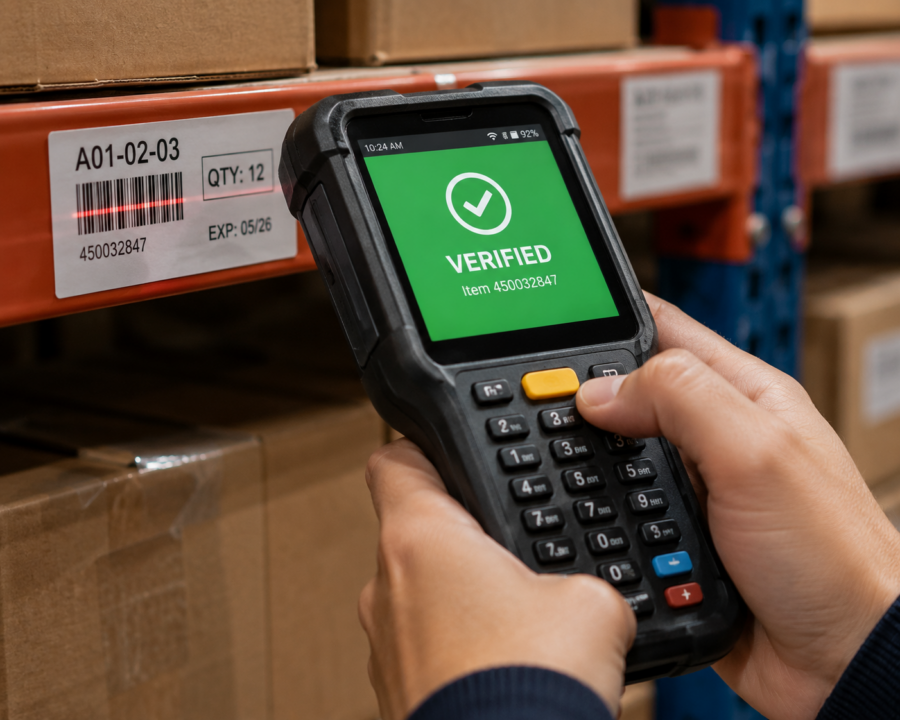
Barcode scanners eliminate one of the biggest sources of human error: visual confirmation. When an item is scanned against an order, any mismatch is caught immediately before shipment.
Pick-to-light systems guide pickers directly to the correct location and can achieve accuracy rates of 99% or higher. For high-SKU or visually similar items, image-based verification adds protection without slowing throughput.
No single picking method fits every operation. Most warehouses use a combination.
Using the wrong method, batch picking in a high-SKU environment without strong system support, for example, is a frequent cause of errors. Even the best picking method will fail without real-time system support.
A warehouse management system is the operational backbone of high-accuracy picking.
A WMS:
Without real-time visibility, pickers rely on static information that may already be outdated, creating the conditions for location errors and quantity mismatches.
Poorly structured picking lists are a preventable error source.
Every list should include:
Sequence picking lists based on warehouse flow, not alphabetically. Standardization reduces cognitive load and helps catch errors during the pick, not after shipping.
Technology reduces error conditions, but engaged teams prevent errors. Pickers who understand their accuracy rate, see how it compares to team benchmarks, and receive recognition for improvement are measurably more careful and consistent.
Platforms like vaibe make KPIs such as picking accuracy visible and motivating, turning daily targets into a shared performance experience rather than a management metric.
Even top-performing warehouses experience errors. What matters is the response.
Regular audits should:
Use root cause analysis to drive systemic fixes: layout, labeling, or process changes.
CIN, a Portuguese paint and coatings manufacturer, struggled with inconsistent productivity and limited visibility into individual performance.
With vaibe, CIN introduced:
Results:
The key shift was not adding more hardware, it was making performance data meaningful to the people doing the work.
How can you prevent picking errors in a warehouse?
Combine optimized layout, barcode verification, the right picking method, and standardized documentation. Equally important is a culture of accountability with clear targets, real-time feedback, and recognition.
What is an acceptable picking accuracy rate?
Most warehouses operate at 96–98%. Best-in-class operations target 99.5% or higher. Anything below 99% should trigger an operational review for high-volume environments.
What causes the most picking errors?
The most common causes are poor layout, adjacent similar SKUs, inadequate labeling, lack of barcode verification, unclear picking lists, and low team engagement.
How does a WMS reduce picking errors?
A WMS assigns optimized pick paths, maintains real-time inventory data, sequences picking lists logically, and flags discrepancies before shipment.
What’s the difference between zone, batch, and wave picking?
The right method depends on SKU count, order volume, and demand patterns.


Share:


Frontline workers keep operations running, but productivity challenges like low engagement, unclear communication, and lack of recognition can quickly impact performance.
With markets fragmenting and consumers demanding more value, retail’s next battleground is operational consistency.
Retail’s productivity crisis isn’t a technology problem, it’s a people problem.
The Frontline Reset explores why frontline turnover is eroding performance in retail and what leading companies are doing to build stable, high-performing teams.
Understand how to immediately start boosting business productivity with gamification tools that drive real results.