


Learn what retail store operations include, why frontline execution decides store performance, and 5 strategies to improve consistency across locations.

Back to Blog
Executive Summary
Retail store operations are the daily systems, routines, and standards that keep a physical store selling: inventory management, staffing, customer service, merchandising, transactions, and compliance. In most retail businesses, those processes are well documented. What varies is whether they are executed the same way in every store, on every shift.
That variation is expensive. Retailers that close the gap between the plan set at head office and the work done on the floor protect margin, lift customer satisfaction, and slow the turnover that quietly removes operating knowledge from the business.
This article covers what retail store operations include, why frontline engagement decides store execution, the barriers that create inconsistency across multiple locations, and five strategies to improve daily performance.
Two stores in the same chain run the same planogram, the same promotion, and the same training program. One hits its numbers. The other spends the shift redoing work that was already done once.
The difference is rarely the strategy. It is what happens between a directive leaving head office and a task being completed correctly on the floor.
Retail store operations are the day-to-day activities, systems, and standards that keep a physical store running profitably, covering inventory management, staffing and scheduling, customer service, merchandising, transactions, and compliance.
Retail operations management is the discipline of running those functions across multiple locations. Store operations are where that discipline either holds or breaks down.
| Store operations function | What it covers | Execution metric |
| Inventory management | Replenishment, stock levels, cycle counts, shrinkage control | In-stock rate, shrinkage rate |
| Staffing and scheduling | Matching labor to demand across shifts and locations | Sales per labor hour |
| Customer service | Greeting, advising, and resolving issues on the sales floor | Conversion rate, CSAT |
| Merchandising and standards | Planograms, displays, signage, promotional setup | On-time task completion |
| Transactions and cash handling | POS system accuracy, returns, end-of-day reconciliation | Transaction error rate |
| Compliance and regular audits | Safety, brand standards, process verification | Audit pass rate |
Every one of those functions depends on a person completing a task correctly, on time, and usually without a manager watching. That is why store operations are a people problem before they are a systems problem.
Employee engagement is an operational input in retail, not a soft HR metric. Business units in the top quartile for engagement record 23% higher profitability, 18% higher sales productivity, and 28% less shrinkage than bottom-quartile units.
Shrinkage is worth pausing on. Most retailers treat it as a security question, yet it moves measurably with how attentive and invested the team on the floor is.
The customer feels the same difference. McKinsey analyzed employee and customer experience data across more than 100 retailers and found that companies with a top-quartile employee experience are more than twice as likely to achieve top-quartile customer satisfaction. Few operational levers double the odds of anything.
Four barriers show up repeatedly in multi-location retail, and none of them is a strategy problem.
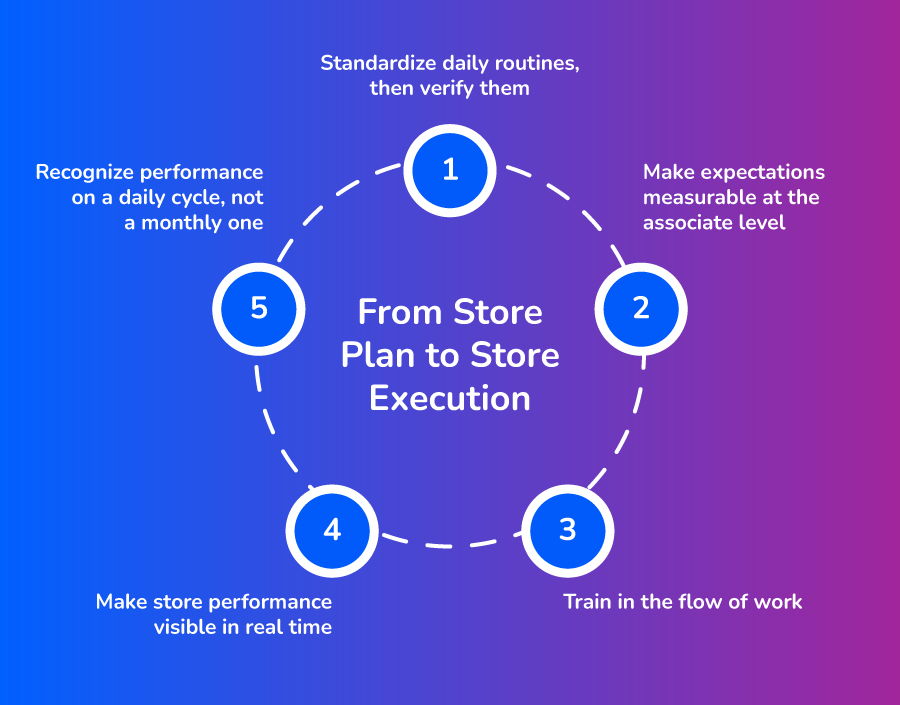
The first two strategies are structural fixes most retailers can start this quarter. The last three are what holds the gains in place shift after shift.
Write opening, replenishment, and closing routines as sequenced task lists with named owners and deadlines, then move them off paper and out of verbal handover. Digital checklists with photo verification turn regular audits into a continuous signal, so a missed planogram reset is caught the same shift.
Store-level targets rarely change individual behavior, because no associate can see their own contribution inside a store number. Break goals down to what a person controls during a shift: units per transaction, conversion, on-time task completion, stock accuracy. Specificity is what makes self-correction possible.
Frontline retail teams do not have blocks of desk time for training modules. Short, task-linked training delivered on a mobile device at the moment it is needed shortens the ramp for new hires and keeps product knowledge current across the floor.
A weekly report arrives after the shift that produced it, which makes it a record rather than a tool. Store-level data that updates during the day lets a manager rebalance the floor at 2pm instead of explaining the shortfall on Monday.
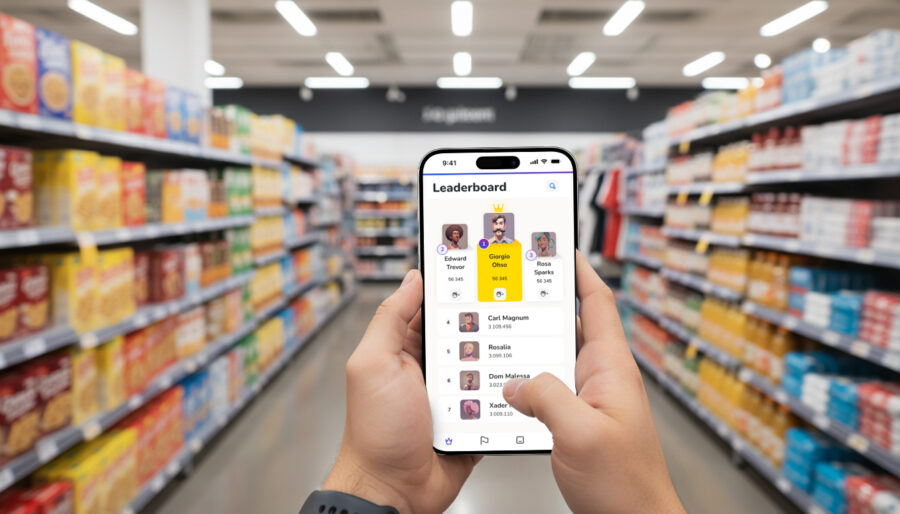
This is where vaibe adds a layer standard dashboards do not: it translates operational KPIs into daily challenges and team leaderboards at the associate level and delivers recognition the moment a target is hit, without requiring a manager to be in the room.
Recognition delivered at a monthly review sits too far from the behavior it is meant to reinforce. Gamification closes that distance by turning daily KPIs into visible challenges, streaks, and milestones associates can act on during the shift. Designed around meaningful work it builds habits, designed around controlling rewards it invites metric-gaming.
CITY Furniture, a Florida-based home furnishings retailer, runs four distribution centers behind its showrooms, the largest at 1.3 million square feet. The operational data already existed. What was missing was a way to turn it into daily motivation and recognize good work the moment it happened rather than at the end of a review cycle.
Working with vaibe and Elite Rewards, CITY Furniture converted KPI-linked tasks into daily challenges with leaderboards, coins, and progress tracking, so associates could see where they stood during the shift. Earned coins were redeemed instantly through a self-service reward marketplace, with no manager approval and no waiting.
Results:
Brent Roberts, Managing Director of Operations at CITY Furniture, framed the goal as challenging and rewarding associates for going above and beyond. The transferable lesson for store operations: recognition loses most of its power the moment it must wait for a manager’s calendar.
Retail store operations are the day-to-day activities, systems, and standards that keep a physical store running profitably. They cover inventory management, staffing and scheduling, customer service, merchandising and store standards, POS and cash handling, and compliance and regular audits. Retail operations management is the wider discipline of running those functions consistently across multiple locations.
Improve store execution by standardizing daily routines as verified digital tasks, breaking store targets down to associate-level goals, training in the flow of work, and giving managers real-time performance data instead of weekly reports. Consistency comes from closing the gap between what head office assigns and what is confirmed complete on the floor.
The core operational KPIs are sales per labor hour, in-stock rate, shrinkage rate, on-time task completion, conversion rate, and units per transaction. Pair these with customer measures such as CSAT or NPS by store, so efficiency gains are never made at the expense of the shopping experience.
Employee engagement is a direct operational lever in retail. Gallup research shows top-quartile engaged business units deliver 23% higher profitability, 18% higher sales productivity, and 28% less shrinkage than bottom-quartile units. Engaged associates also stay longer, which protects the store knowledge that consistent execution depends on.
Gamification turns operational KPIs into visible daily challenges, progress tracking, and recognition, giving associates a concrete reason to adjust their behavior during the shift rather than after a monthly review. The practical effect is more consistent task completion and faster adoption of new targets in high-turnover frontline roles.
Share:


Improve store performance with practical ways to raise sales per labor hour, sharpen execution, and boost engagement with clearer goals and real-time visibility.
See how CITY Furniture used vaibe’s operational performance layer to drive an 11% productivity increase, improve retention rates, and strengthen the relationship between leaders and associates on the warehouse floor.
Discover how gamification adds value to your software, positions you as a market differentiator and helps you tackle your clients’ challenges effectively.
Discover how gamification enhances your software offering, drives customer engagement and productivity and sets your platform apart in the market.