


Improve store performance with practical ways to raise sales per labor hour, sharpen execution, and boost engagement with clearer goals and real-time visibility.

Back to Blog
Executive Summary
Retail productivity is how efficiently a store converts its resources (people, time, space) into sales and customer value. With labor accounting for 10–25% of retail sales and customer expectations at an all-time high, it has become a strategic priority, not just an operational one.
This article examines what retail productivity means in practice, the key barriers that hold stores back, and five proven strategies to boost retail productivity. From workflow optimization and goal setting to real-time performance visibility, see what it takes to run a high-performing store.
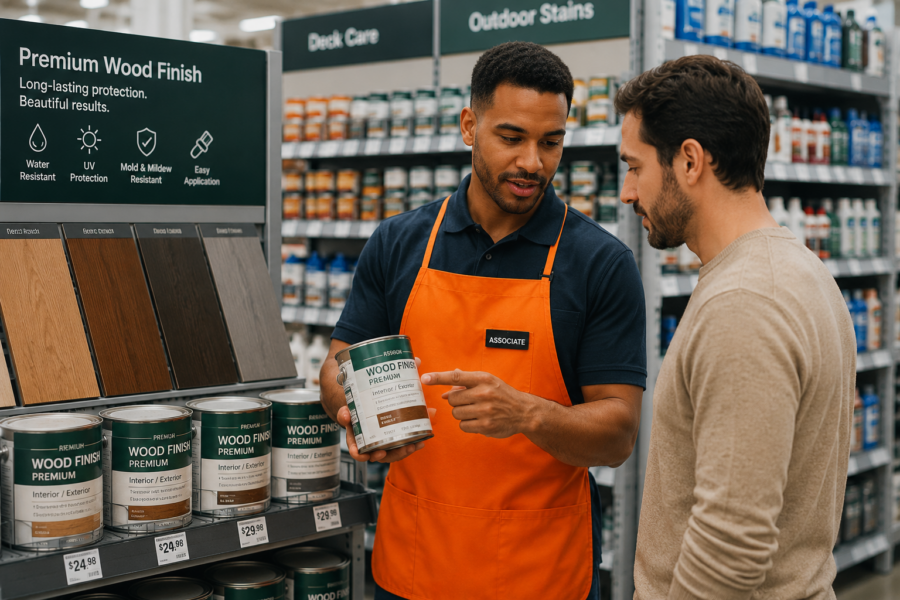
Retail margins are thinner than ever. Labor costs alone represent 10 to 25% of total sales depending on the format, and rising wages mean that pressure only grows. Meanwhile, customers expect faster service, better product knowledge, and a consistent in-store experience across every location. The gap between what a store could deliver and what it actually delivers is a productivity gap, and it costs retailers money every day.
To boost retail productivity, most teams do not need more staff or bigger budgets. What they need are clearer goals, better visibility, and operational habits that are built to last.
Retail productivity is the measure of how efficiently a store converts its inputs (labor, time, floor space, and inventory) into outputs such as revenue generated, customer satisfaction, and operational results.
High-productivity retail teams achieve higher sales per labor hour, deliver better customer experiences, and execute operations with fewer errors. Low-productivity teams often work just as hard, but without the structure or visibility to channel that effort where it counts.
The most commonly tracked metrics include:
Retail labor productivity grew 4.6% in 2024, according to the U.S. Bureau of Labor Statistics, driven by output growth outpacing hours worked. That headline masks a more complex reality at the store level, where inconsistent execution, poor scheduling, and disengaged teams still leave significant revenue on the table.
Labor is the largest controllable cost in most retail operations. McKinsey research found that activity-based scheduling can reduce labor costs by up to 12% while improving customer service and employee satisfaction. According to Gallup’s 2026 workplace research, organizations with high employee engagement see 23% higher productivity and 10% greater customer loyalty. In retail, that connection is a commercial lever, not a soft one.
Several patterns consistently hold stores back:
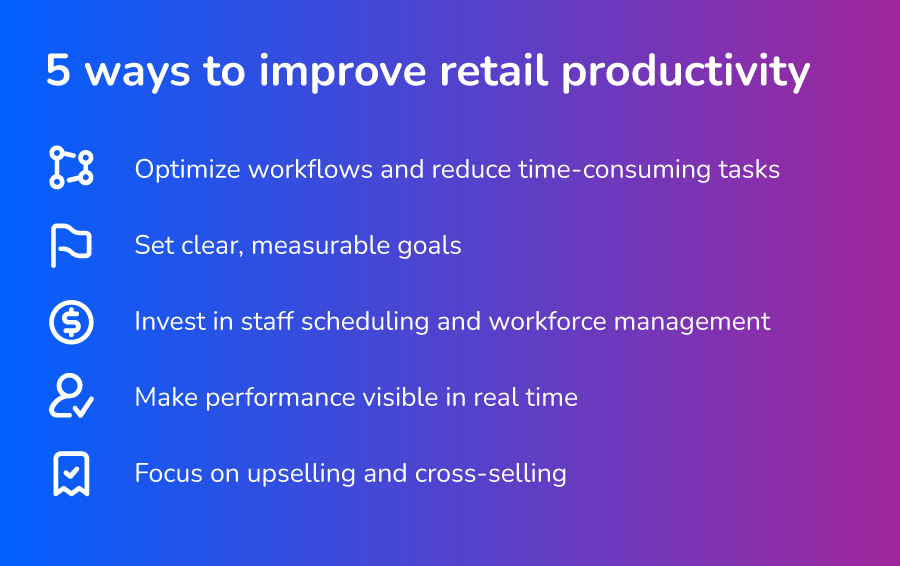
Map the daily tasks associates perform and identify where time is lost. Processes like shelf replenishment, opening routines, and inventory counts can often be restructured to improve operational efficiency. Even small changes, such as reducing unnecessary movement or clarifying task ownership, can add up across a full week.
To improve retail productivity, start with specificity. Set daily or weekly targets for sales per labor hour, conversion rate, and UPT. Break store-level goals into team and individual levels so accountability is concrete. Associates who track their own progress adjust their behavior in real time.
Activity-based scheduling, matching headcount to actual workload patterns, reduces idle time during slow periods and prevents service failures at peak hours. Better workforce management is one of the fastest routes to improved operational efficiency without adding labor costs.
Managers and associates who can see their numbers during the day can adjust before the shift ends. vaibe goes further than standard dashboards by translating KPIs into daily behaviors at the associate level through real-time challenges, team leaderboards, and recognition that does not depend on a manager being in the room. In high-turnover retail environments, that distinction matters.
Revenue per transaction is one of the most accessible levers to boost retail productivity, as it requires no additional labor hours. Train associates on product pairing, surface add-ons naturally in conversation, and track UPT as a visible team metric. Small improvements in basket size compound quickly across high-traffic stores.
CITY Furniture faced a familiar challenge: motivated teams, but inconsistent performance across locations and difficulty sustaining engagement in high-turnover retail roles.
Working with vaibe, they introduced a gamification-based performance layer across their store network. KPIs became visible, real-time challenges teams could track and compete on, without adding management overhead. Recognition was built into daily operations, not reserved for end-of-month reviews.
Within the first months of rollout:
The gains came from higher engagement with existing processes, not from new ones.
What is the best metric to measure retail productivity?
Sales per labor hour (SPLH) is the most direct measure, linking financial output to labor input. For a complete picture, combine it with conversion rate, units per transaction, and customer satisfaction scores.
How can store managers improve retail productivity without increasing labor costs?
Most gains come from better use of existing resources: smarter scheduling, clearer goals, real-time feedback, and structured communication. Improving employee engagement is particularly high-return: engaged teams are more productive, deliver stronger service, and turn over less.
What role does employee engagement play in retail productivity?
Employee engagement is a direct driver of store performance. Gallup data shows engaged organizations achieve 23% higher productivity and 10% greater customer loyalty. Stores where employees feel recognized and have clear goals consistently outperform those that do not.
What are upselling and cross-selling, and why do they matter?
Upselling encourages a customer to choose a higher-value product; cross-selling surfaces complementary items. Both increase revenue generated per transaction without requiring more customers or labor hours, making them among the most efficient productivity levers in retail.
Share:


Discover the key retail KPIs that help stores improve efficiency, optimize operations, and drive stronger business performance.
Discover how gamification enhances your software offering, drives customer engagement and productivity and sets your platform apart in the market.
CIN had continuous improvement routines in place but performance data only arrived the next day. See how vaibe’s operational performance layer gave teams real-time visibility for the first time, driving a 13% productivity increase across two sites.