


Discover five practical ways to improve productivity, reduce avoidable labor costs, and boost engagement with real-time visibility, cross-training, and gamification.

Back to Blog
Executive Summary
Labor costs account for up to 70% of total business expenses. In most organizations, that makes the workforce the largest controllable cost, and the clearest lever for improving margins. Even a 5% productivity improvement in a labor-intensive operation can generate significant bottom-line impact without adding headcount.
This article covers what labor optimization means, why it matters, and five practical strategies that operations and HR leaders use to drive results.

Most organizations know their labor costs are high, fewer have a clear plan to bring them under control without sacrificing quality or people. According to the U.S. Bureau of Labor Statistics, labor can account for as much as 70% of total business costs. Yet, workforce performance is still managed through lagging reports and annual reviews in many companies. That gap is expensive.
Labor optimization is the process of aligning workforce capacity, skills, and output with business demand to maximize productivity while minimizing unnecessary labor costs.
It covers more than scheduling. Effective labor optimization addresses how work is planned, communicated, measured, and improved: whether people are clear on expectations, motivated to perform, and supported with timely data. In industries where labor runs at 40–60% of gross revenue, even small efficiency gains translate directly to the bottom line.
Cost pressure is one driver. Mercer projects total health benefit costs per employee will rise 5.8% in 2025, while salary budget growth is slowing. Businesses are being asked to produce more with the same resources.
Engagement is the other driver, and arguably the larger one. Gallup’s 2026 State of the Global Workplace report found that the world’s employee engagement has dropped to 20%, costing the world economy an estimated $10 trillion in lost productivity annually. Highly engaged teams, by contrast, deliver greater profitability and higher productivity. Labor optimization addresses both problems at once.
Most organizations want to improve workforce performance. The barriers are usually about visibility, systems, and culture. The most common blockers are:
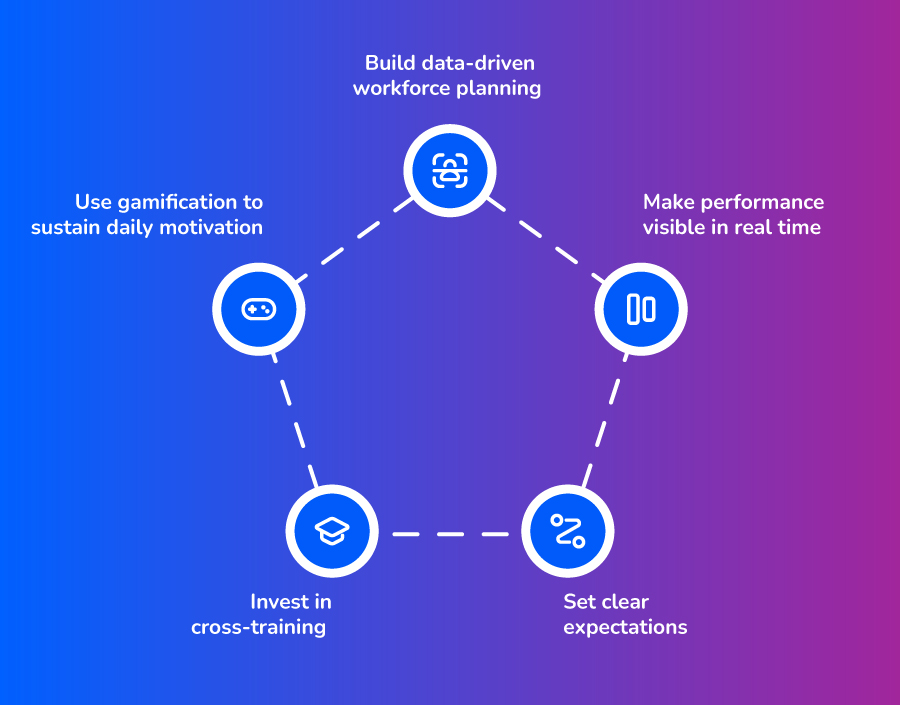
Match staffing levels to actual demand, not last quarter’s average. Data-driven planning reduces idle time during slow periods, enables faster response to demand spikes without expensive overtime, and produces more accurate hiring decisions based on real capacity gaps.
Visibility changes behavior. When employees can see how their output compares to team targets in real time, they self-correct faster. Managers spend less time chasing reports and more time coaching. The most effective performance visibility is granular enough to show individual and team-level data and framed around progress rather than surveillance.
Performance targets should be specific and communicated consistently, not buried in a quarterly review. Every team member should understand what “good” looks like for their role and how it connects to broader operational goals. This is often the easiest win available: it requires discipline, not new technology.
Teams where employees are skilled across multiple functions absorb demand shifts without adding headcount. Cross-training also signals investment in employee growth, which directly improves retention. Linking skills data to performance tracking helps managers identify whether a dip in output reflects a staffing gap, a training gap, or something else.
Recognition programs and bonuses help, but they operate on long cycles. Gamification makes performance motivating daily by turning KPIs into challenges, leaderboards, and milestone-based rewards that give frontline teams a visible reason to improve. Platforms like vaibe translate goals and daily behaviors into structured performance journeys that drive consistent execution. Organizations using vaibe have reported productivity gains of 5–11%, alongside improvements in accuracy and attendance.
CITY Furniture, a high-volume US furniture retailer, needed to keep productivity consistently high across a large frontline workforce with varying skill levels and shift patterns.
The company deployed vaibe to convert daily KPIs into gamified performance challenges. Teams tracked their rankings in real time and received recognition tied directly to measurable output.
Results:
The core lesson: performance culture isn’t built through policy alone. When the right behaviors are visible, recognized, and rewarded daily, improvements compound over time.
What is labor optimization, and how is it different from workforce management?
Labor optimization is the strategic practice of aligning workforce capacity, skills, and output with business demand to maximize productivity and minimize unnecessary costs. Workforce management covers the operational mechanics (scheduling, time tracking, compliance). Labor optimization is broader: it includes how performance is measured, motivated, and improved over time.
What are the most effective labor optimization strategies?
The highest-impact strategies are data-driven workforce planning matched to actual demand; real-time performance transparency; clearly communicated KPIs; cross-training to build workforce flexibility; and recognition or gamification programs that sustain daily motivation. Results are best when these are combined rather than applied in isolation.
How does employee engagement affect labor optimization?
Gallup research shows highly engaged teams outperform disengaged ones by 17% in productivity and 23% in profitability. Disengagement also drives turnover, one of the highest hidden costs in labor-intensive industries. Engagement is a direct input to both labor cost and output quality.
How can gamification support labor optimization?
Gamification makes performance tangible daily. By turning KPIs into challenges and milestones, it gives employees a clear view of their progress and a concrete reason to improve, rather than waiting for quarterly reviews. The practical effect is higher output consistency, faster adoption of new targets, and lower turnover in frontline roles where recognition is often limited.
How do you reduce labor costs without cutting headcount?
The most sustainable path is improving productivity rather than reducing hours. This means eliminating scheduling inefficiencies, reducing rework from unclear expectations, building workforce flexibility through cross-training, and closing the engagement gap that causes experienced employees to underperform or leave. In most operations, there is substantial room to improve output per hour before any staffing changes are needed.
Share:


Discover the key retail KPIs that help stores improve efficiency, optimize operations, and drive stronger business performance.
Frontline workers face many challenges, and companies who seek long term success need to address these challenges in order to create motivated teams.
Explore how gamification enhances your contact center, sets you apart in the market and empowers you to solve client challenges more effectively.